AUTHENTIC EXAMINATION ARCHIVE
2026 Theory of Computation Question Paper
MCA 2nd Semester Theory of Computation • MPC Autonomous College, Takhatpur, Baripada
- Course
- MCA
- Semester
- Semester 2
- Year
- 2026
- Exam Type
- Regular
MCA 2nd Semester Theory of Computation • MPC Autonomous College, Takhatpur, Baripada
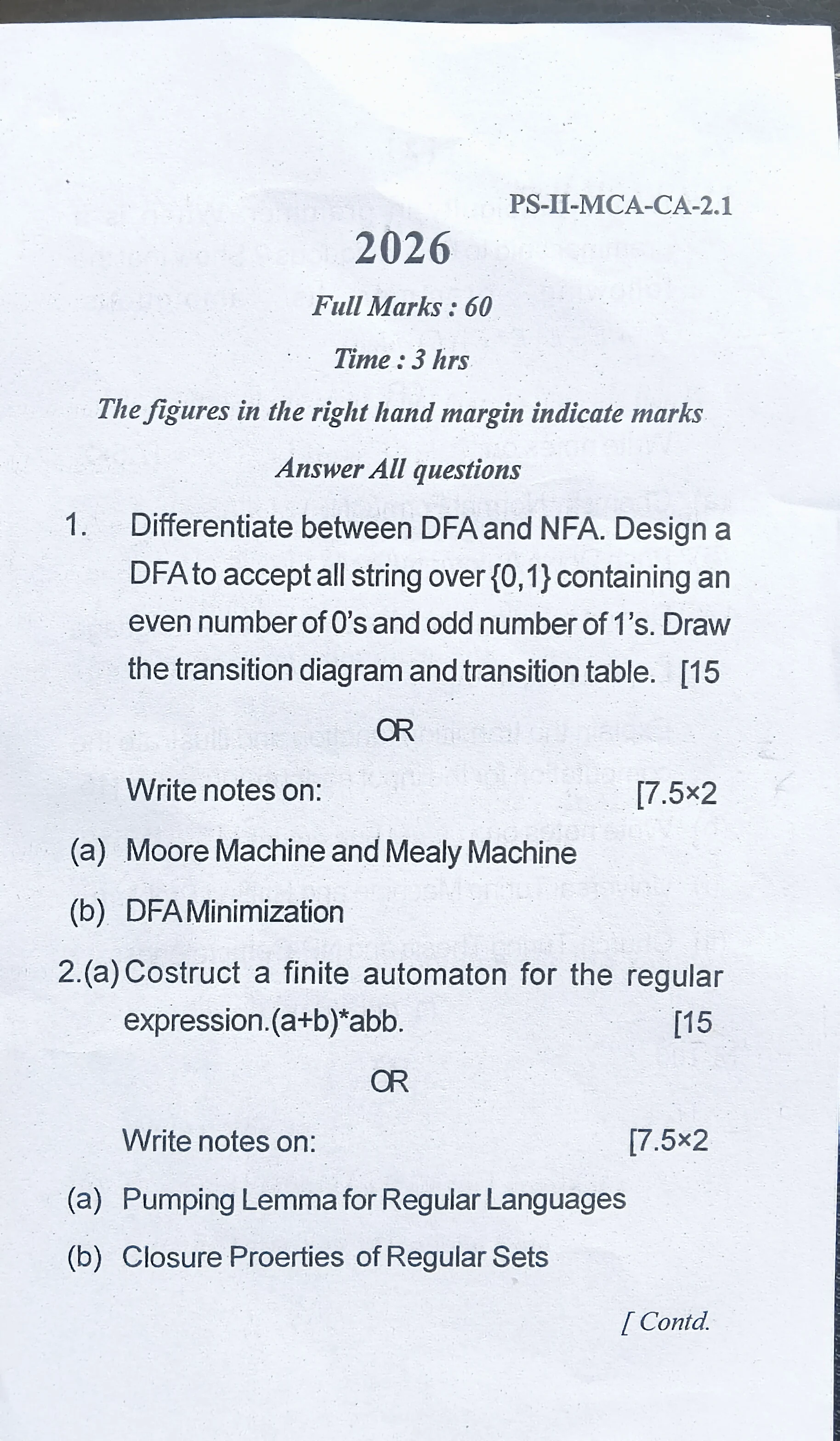
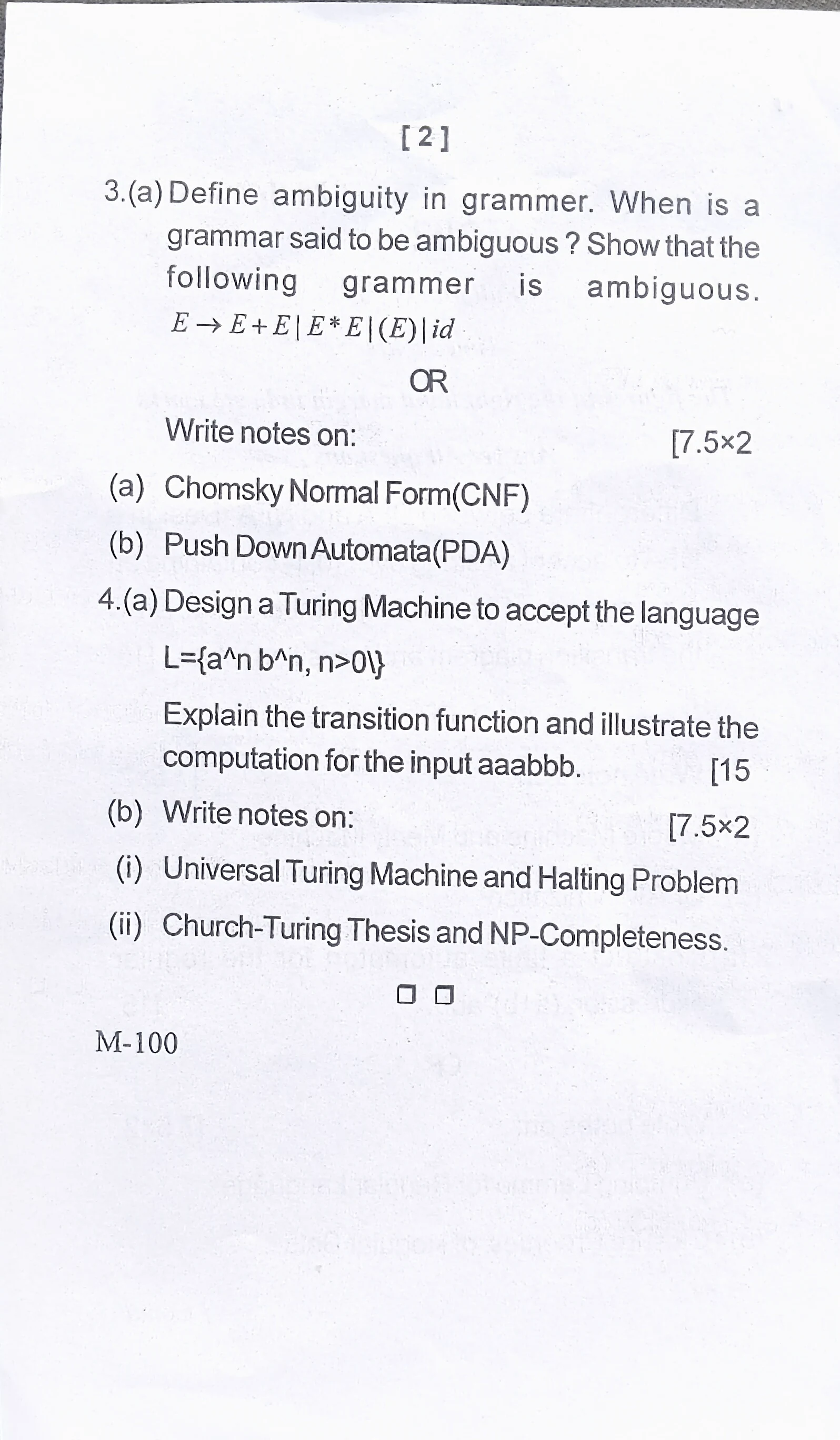
Transcribed questions for Theory of Computation (MCA, Regular 2026) including all sections, choices, marks, equations, and diagrams.
Differentiate between DFA and NFA. Design a DFA to accept all strings over containing an even number of 0's and an odd number of 1's. Draw the transition diagram and transition table.
Write notes on: [7.5 × 2 = 15 Marks]
(a) Construct a finite automaton for the regular expression .
Write notes on: [7.5 × 2 = 15 Marks]
(a) Define ambiguity in grammar. When is a grammar said to be ambiguous? Show that the following grammar is ambiguous:
Write notes on: [7.5 × 2 = 15 Marks]
(a) Design a Turing Machine to accept the language . Explain the transition function and illustrate the step-by-step computation for the input string .
(b) Write notes on: [7.5 × 2 = 15 Marks]