AUTHENTIC EXAMINATION ARCHIVE

2026 Chronobiology, Ecology and Evolution Question Paper

M.SC ZOOL 2nd Semester Chronobiology, Ecology and Evolution • MPC Autonomous College, Takhatpur, Baripada

Course
M.SC ZOOL
Semester
Semester 2
Year
2026
Exam Type
Regular

Original Examination Scans (2)

Verified Pages
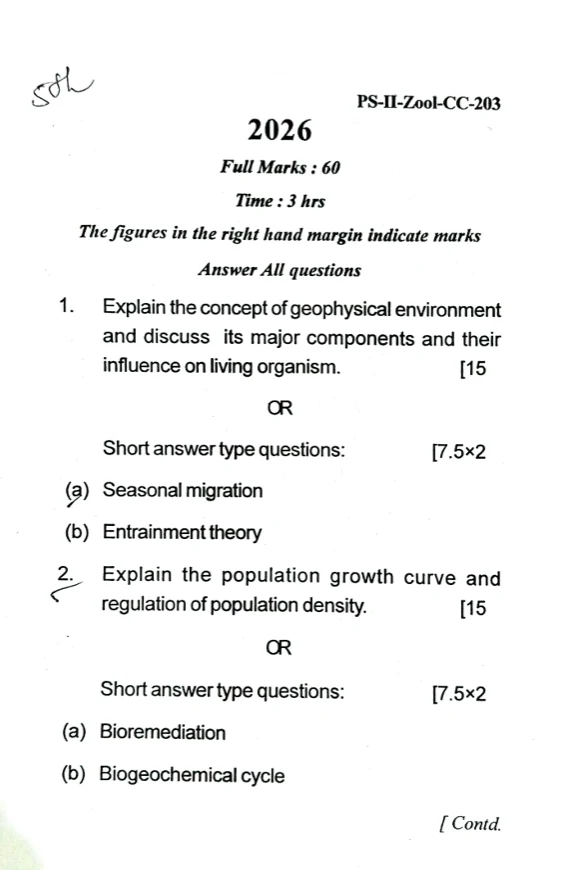
2026 Chronobiology, Ecology and Evolution question paper page 1, MPC Autonomous College, Baripada
Page 1: Chronobiology, Ecology and Evolution (2026)
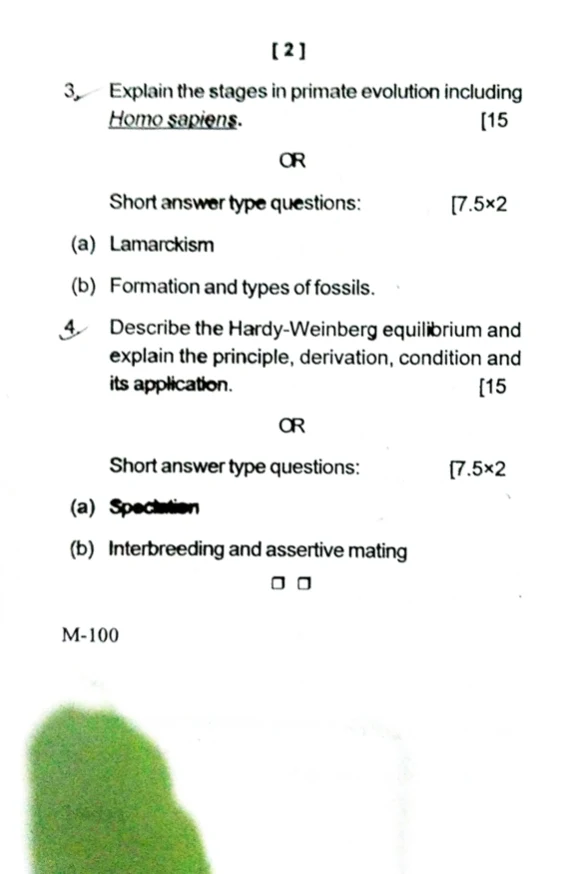
2026 Chronobiology, Ecology and Evolution question paper page 2, MPC Autonomous College, Baripada
Page 2: Chronobiology, Ecology and Evolution (2026)

Chronobiology, Ecology and Evolution (CC-203) 2026 Questions

Transcribed questions for Chronobiology, Ecology and Evolution (M.SC ZOOL, Regular 2026) including all sections, choices, marks, equations, and diagrams.

Chronobiology, Ecology and Evolution (CC-203): Examination Questions

Q.1 [15 Marks]

Explain the concept of geophysical environment and discuss its major components and their influence on living organisms.

OR

Short answer type questions: [7.5 × 2 = 15 Marks]

  1. Seasonal migration in animals
  2. Entrainment theory of circadian pacemakers (Zeitgebers)
Q.2 [15 Marks]

Explain the population growth curve (exponential vs logistic) and regulation of population density (density-dependent vs density-independent factors).

OR

Short answer type questions: [7.5 × 2 = 15 Marks]

  1. Bioremediation techniques and microbial cleanup
  2. Biogeochemical cycles (Carbon, Nitrogen and Phosphorus cycles)
Q.3 [15 Marks]

Explain the stages in primate evolution including the origin and lineage leading to Homo sapiens.

OR

Short answer type questions: [7.5 × 2 = 15 Marks]

  1. Lamarckism and its modern critique
  2. Formation and types of fossils in paleontology
Q.4 [15 Marks]

Describe the Hardy-Weinberg equilibrium and explain the principle, derivation (), conditions for validity, and its biological applications.

OR

Short answer type questions: [7.5 × 2 = 15 Marks]

  1. Speciation mechanisms (Allopatric, Sympatric, and Parapatric)
  2. Inbreeding and assortative mating in population genetics