2025 Chronobiology, Ecology and Evolution Question Paper
M.SC ZOOL 2nd Semester Chronobiology, Ecology and Evolution • MPC Autonomous College, Takhatpur, Baripada
- Course
- M.SC ZOOL
- Semester
- Semester 2
- Year
- 2025
- Exam Type
- Regular
M.SC ZOOL 2nd Semester Chronobiology, Ecology and Evolution • MPC Autonomous College, Takhatpur, Baripada
Transcribed questions for Chronobiology, Ecology and Evolution (M.SC ZOOL, Regular 2025) including all sections, choices, marks, equations, and diagrams.
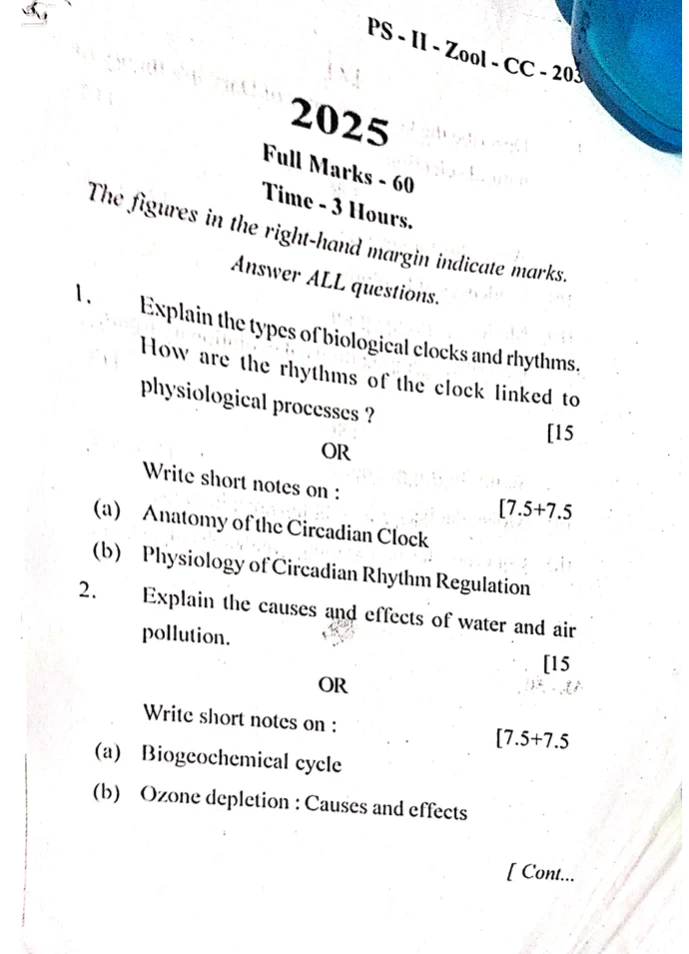
(a) Define circadian rhythm. Describe the molecular transcription-translation autoregulatory feedback loop of biological clocks in mammals involving , , (1, 2, 3), and (1, 2) proteins, and the central pacemaker role of the Suprachiasmatic Nucleus (SCN).
(b) Explain photoperiodism. Discuss physiological, neuroendocrine, and behavioral adaptations governing seasonal breeding and migration in birds and mammals.
(a) Discuss aquatic ecosystem degradation by point and non-point pollution sources. Detail Biological Oxygen Demand (BOD), Chemical Oxygen Demand (COD), biomagnification of xenobiotics, and cultural eutrophication control strategies.
(b) Describe biogeochemical cycles in ecosystems. Detail the sedimentary Phosphorus cycle and gaseous Carbon cycle, highlighting anthropogenic perturbations and global climate change.
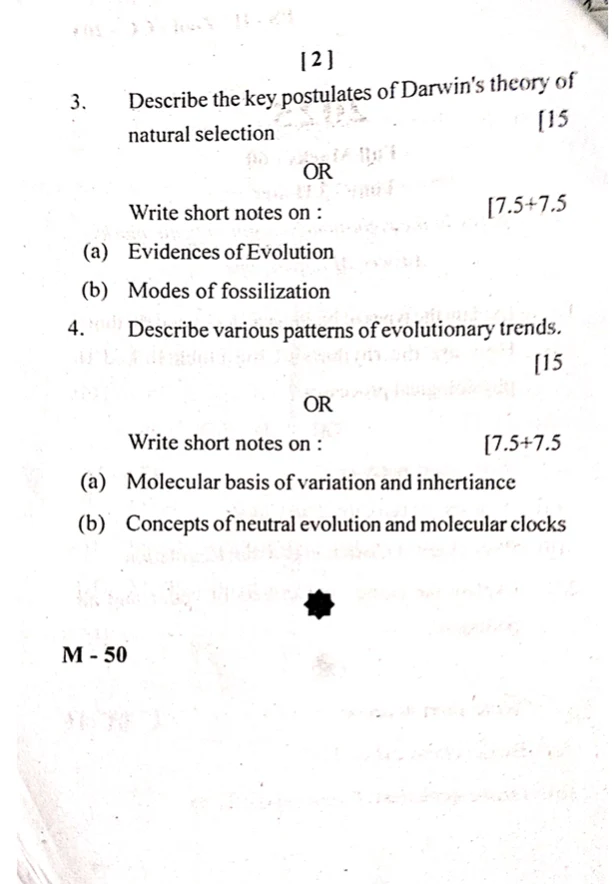
(a) Discuss Darwinian evolutionary theory and the Modern Synthetic Theory of Evolution (Neo-Darwinism). Explain stabilizing, directional, and disruptive natural selection with graphical illustrations.
(b) State and prove the Hardy-Weinberg law of genetic equilibrium:
Explain the five evolutionary evolutionary forces that upset Hardy-Weinberg equilibrium: mutation, gene flow/migration, genetic drift (founder effect and bottleneck), non-random mating, and natural selection.
(a) Describe the concept of Molecular Clock in molecular phylogenetics. Explain neutral theory of molecular evolution, calculating divergence times from nucleotide and amino acid substitution rates, and constructing rooted phylogenetic trees.
(b) Write detailed notes on: