AUTHENTIC EXAMINATION ARCHIVE

2025 Taxonomy and Biosystematics/Entomology and Applied Zoology Question Paper

M.SC ZOOL 4th Semester Taxonomy and Biosystematics/Entomology and Applied Zoology • MPC Autonomous College, Takhatpur, Baripada

Course
M.SC ZOOL
Semester
Semester 4
Year
2025
Exam Type
Regular

Original Examination Scans (1)

Verified Pages
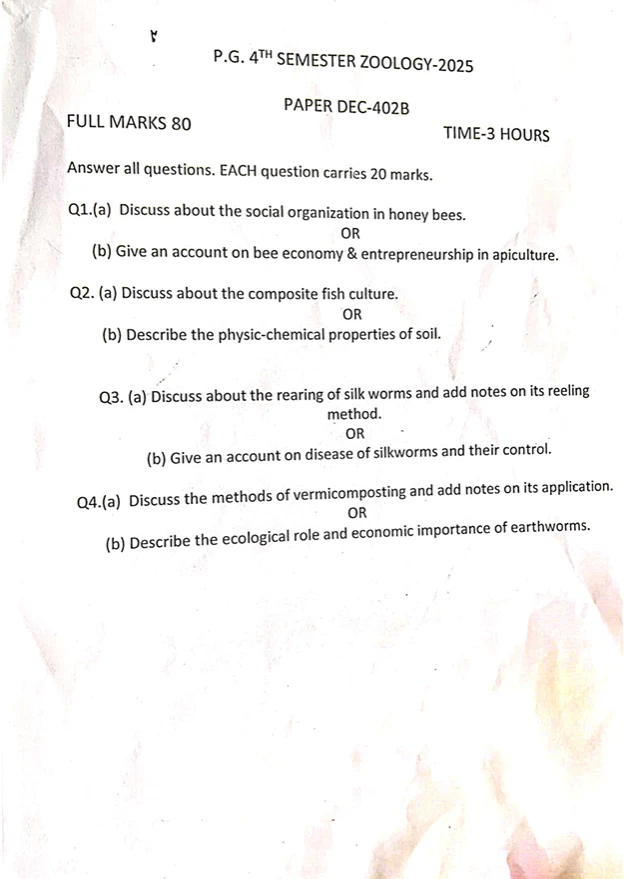
2025 Taxonomy and Biosystematics/Entomology and Applied Zoology question paper page 1, MPC Autonomous College, Baripada
Page 1: Taxonomy and Biosystematics/Entomology and Applied Zoology (2025)

Taxonomy and Biosystematics/Entomology and Applied Zoology (DEC-402B) 2025 Questions

Transcribed questions for Taxonomy and Biosystematics/Entomology and Applied Zoology (M.SC ZOOL, Regular 2025) including all sections, choices, marks, equations, and diagrams.

Unit 1 - Apiculture & Social Insects

Q.1 [20 Marks]

(a) Discuss about the social organization in honey bees (Apis mellifera / Apis cerana indica). Detail caste differentiation (Queen, Drone, Worker), division of labor based on age polyethism, and dance language communication (round and waggle dances).

OR

(b) Give an account on bee economy & entrepreneurship in commercial apiculture. Describe apiary site selection, honey extraction, and economic value of bee by-products: beeswax, royal jelly, propolis, bee pollen, and bee venom.

Unit 2 - Aquaculture & Soil Ecology

Q.2 [20 Marks]

(a) Discuss about the composite fish culture (polyculture). Explain ecological niche compatibility and feeding habits of Indian Major Carps (Catla catla, Labeo rohita, Cirrhinus mrigala) and Exotic Carps (Hypophthalmichthys molitrix, Ctenopharyngodon idella, Cyprinus carpio), along with pre-stocking and post-stocking pond management.

OR

(b) Describe the physico-chemical properties of soil critical for aquaculture pond productivity and agriculture: soil texture, soil pH, organic carbon content, nitrogen-phosphorus balance, and cation exchange capacity (CEC).

Unit 3 - Sericulture & Silkworm Pathology

Q.3 [20 Marks]

(a) Discuss about the rearing of silk worms (Bombyx mori) and add notes on its reeling method. Detail egg incubation, feeding of instars, bed cleaning, mounting, cocoon harvesting, and modern silk reeling technologies (stifling, cooking, deflossing, reeling, and rereeling).

OR

(b) Give an account on disease of silkworms and their control: Pebrine (microsporidian protozoan Nosema bombycis), Flacherie (bacterial/viral), Grasserie (NPV), and Muscardine (fungal Beauveria bassiana), detailing symptoms, epidemiology, and preventive management.

Unit 4 - Vermiculture & Agro-Ecological Management

Q.4 [20 Marks]

(a) Discuss the methods of vermicomposting and add notes on its application: pit method, heap/windrow method, and bin reactor systems. Detail bed preparation, substrate moisture, temperature control, and agricultural application of vermicompost and vermiwash as organic biofertilizers.

OR

(b) Describe the ecological role and economic importance of earthworms (epigeic species such as Eisenia foetida and Eudrilus eugeniae) in soil aeration, nutrient cycling, humification, and sustainable soil health management.