2025 Data Warehousing and Data Mining Question Paper
MCA 3rd Semester Data Warehousing and Data Mining • MPC Autonomous College, Takhatpur, Baripada
- Course
- MCA
- Semester
- Semester 3
- Year
- 2025
- Exam Type
- Regular
MCA 3rd Semester Data Warehousing and Data Mining • MPC Autonomous College, Takhatpur, Baripada
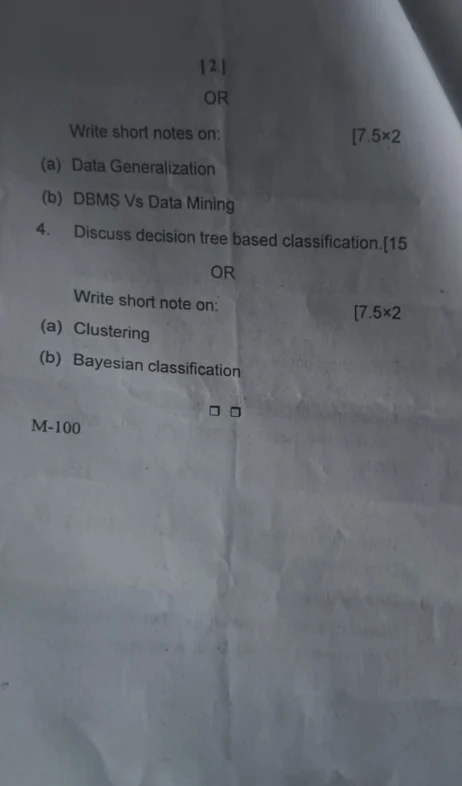
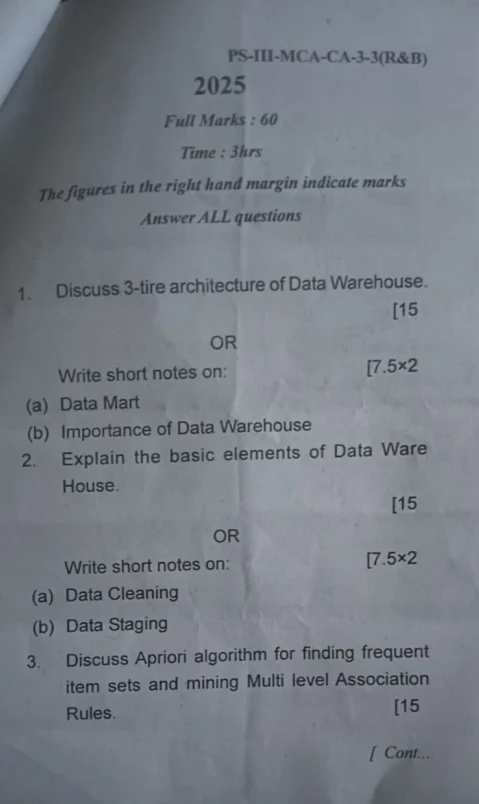
Transcribed questions for Data Warehousing and Data Mining (MCA, Regular 2025) including all sections, choices, marks, equations, and diagrams.
(a) Explain the three-tier Data Warehouse Architecture with a neat schematic diagram detailing the bottom tier (data warehouse server), middle tier (OLAP server), and top tier (front-end client tools).
(b) Differentiate between OLTP and OLAP systems. Explain Star Schema and Snowflake Schema multidimensional data models with example schema diagrams.
(a) Explain the ETL (Extract, Transform, Load) process in data warehousing and describe data staging and metadata management.
(b) What is a Data Mart? Explain the core OLAP operations: Roll-up, Drill-down, Slice, Dice, and Pivot with illustrative cube diagrams.
(a) What is Data Mining? Explain the Knowledge Discovery in Databases (KDD) process steps: Data Cleaning, Integration, Selection, Transformation, Mining, Pattern Evaluation, and Knowledge Presentation.
(b) Explain the Apriori algorithm for mining frequent itemsets and association rules. Define Support, Confidence, and Lift with mathematical formulas.
(a) What is data preprocessing? Explain major data cleaning methods for handling missing values and noisy data (Binning, Regression, Clustering).
(b) Explain the FP-Tree (Frequent Pattern Tree) growth algorithm. Why is FP-Growth more computationally efficient than Apriori?
(a) Explain Decision Tree induction for classification. Describe how splitting attribute selection is performed using Information Gain () and Gini Index.
(b) Explain Naive Bayes classification with Bayes theorem formulation:
(a) What is clustering? Differentiate between partitioning and hierarchical clustering methods.
(b) Explain the -means clustering algorithm with its step-by-step mathematical formulation and discuss its sensitivity to initial centroids and outliers.
(a) Explain Web Mining and differentiate between Web Content Mining, Web Structure Mining (PageRank, HITS), and Web Usage Mining.
(b) Explain Outlier Analysis in data mining. Describe statistical, distance-based, and density-based outlier detection techniques.
(a) Explain Spatial and Temporal Data Mining with real-world applications in GIS and financial forecasting.
(b) Write short notes on: