AUTHENTIC EXAMINATION ARCHIVE
2026 Numerical Methods Question Paper
MCA 2nd Semester Numerical Methods • MPC Autonomous College, Takhatpur, Baripada
- Course
- MCA
- Semester
- Semester 2
- Year
- 2026
- Exam Type
- Regular
MCA 2nd Semester Numerical Methods • MPC Autonomous College, Takhatpur, Baripada
Transcribed questions for Numerical Methods (MCA, Regular 2026) including all sections, choices, marks, equations, and diagrams.
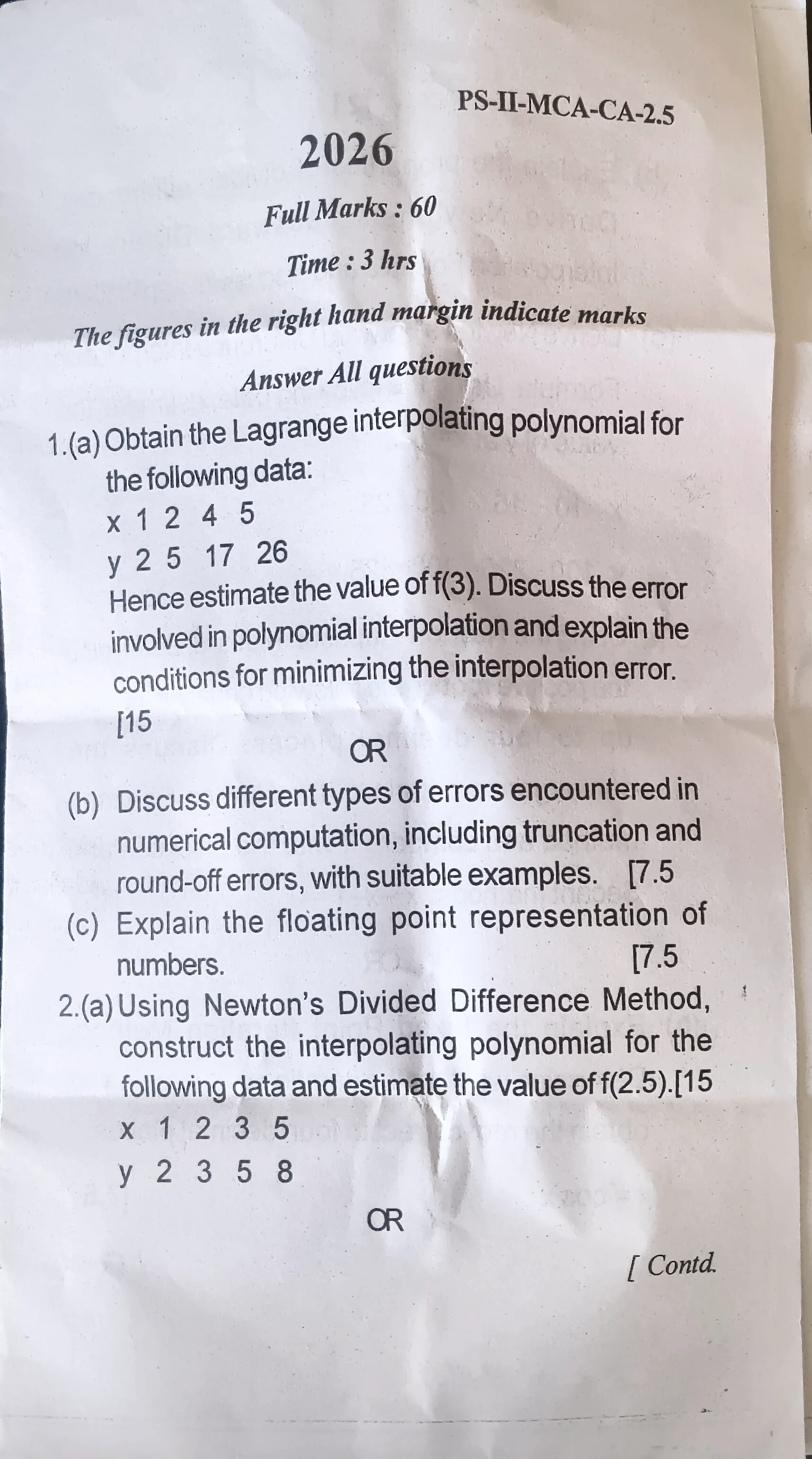
(a) Obtain the Lagrange interpolating polynomial for the following data:
| x | 1 | 2 | 4 | 5 |
|---|---|---|---|---|
| y | 2 | 5 | 17 | 26 |
Hence estimate the value of . Discuss the error involved in polynomial interpolation and explain the conditions for minimizing the interpolation error.
(b) Discuss different types of errors encountered in numerical computation, including truncation and round-off errors, with suitable examples. [7.5 Marks]
(c) Explain the floating point representation of numbers. [7.5 Marks]
(a) Using Newton's Divided Difference Method, construct the interpolating polynomial for the following data and estimate the value of :
| x | 1 | 2 | 3 | 5 |
|---|---|---|---|---|
| y | 2 | 3 | 5 | 8 |
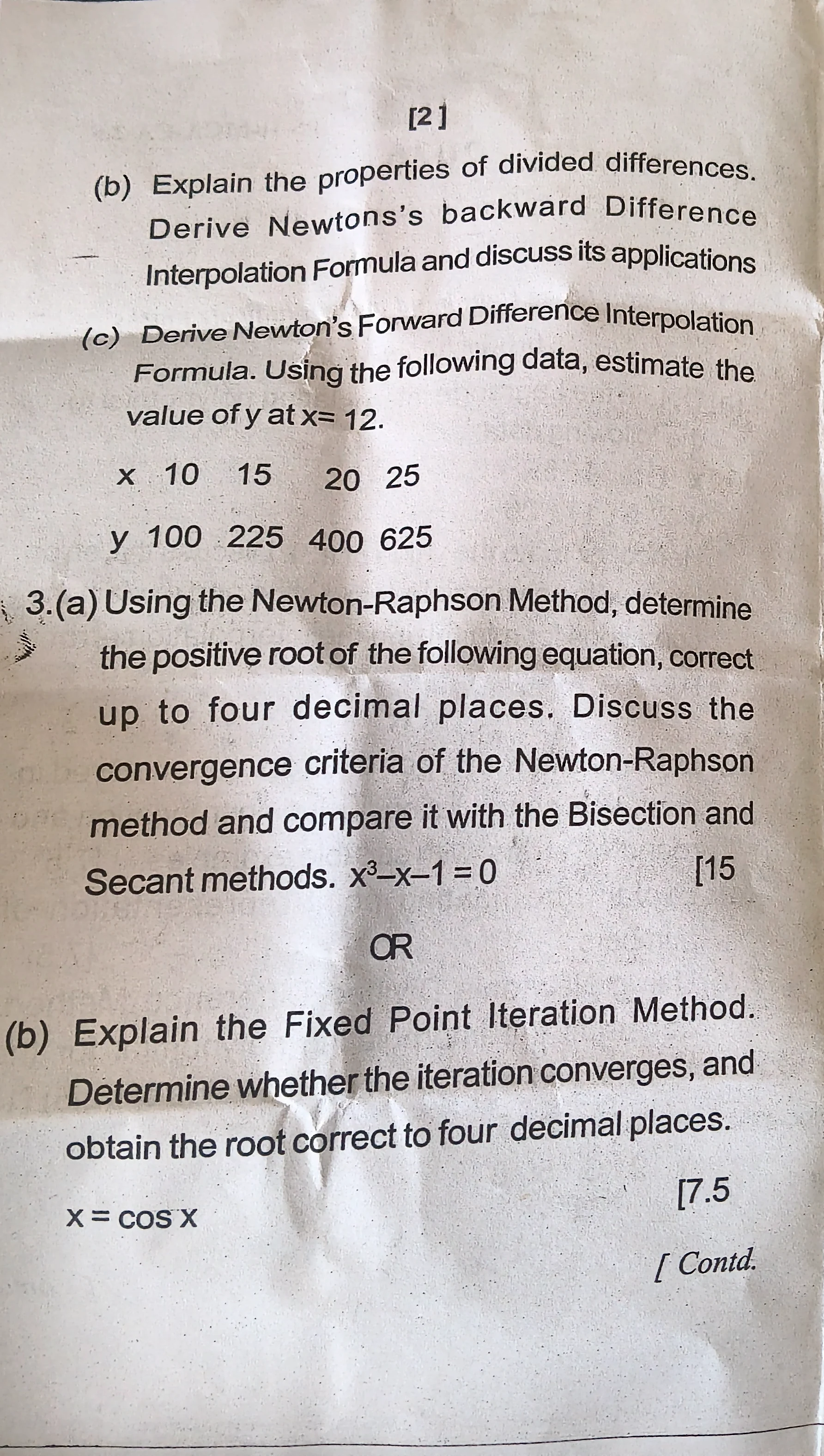
(b) Explain the properties of divided differences. Derive Newton's backward Difference Interpolation Formula and discuss its applications.
(c) Derive Newton's Forward Difference Interpolation Formula. Using the following data, estimate the value of at : [7.5 Marks]
| x | 10 | 15 | 20 | 25 |
|---|---|---|---|---|
| y | 100 | 225 | 400 | 625 |
(a) Using the Newton-Raphson Method, determine the positive root of the following equation, correct up to four decimal places. Discuss the convergence criteria of the Newton-Raphson method and compare it with the Bisection and Secant methods:
(b) Explain the Fixed Point Iteration Method. Determine whether the iteration converges, and obtain the root correct to four decimal places for . [7.5 Marks]
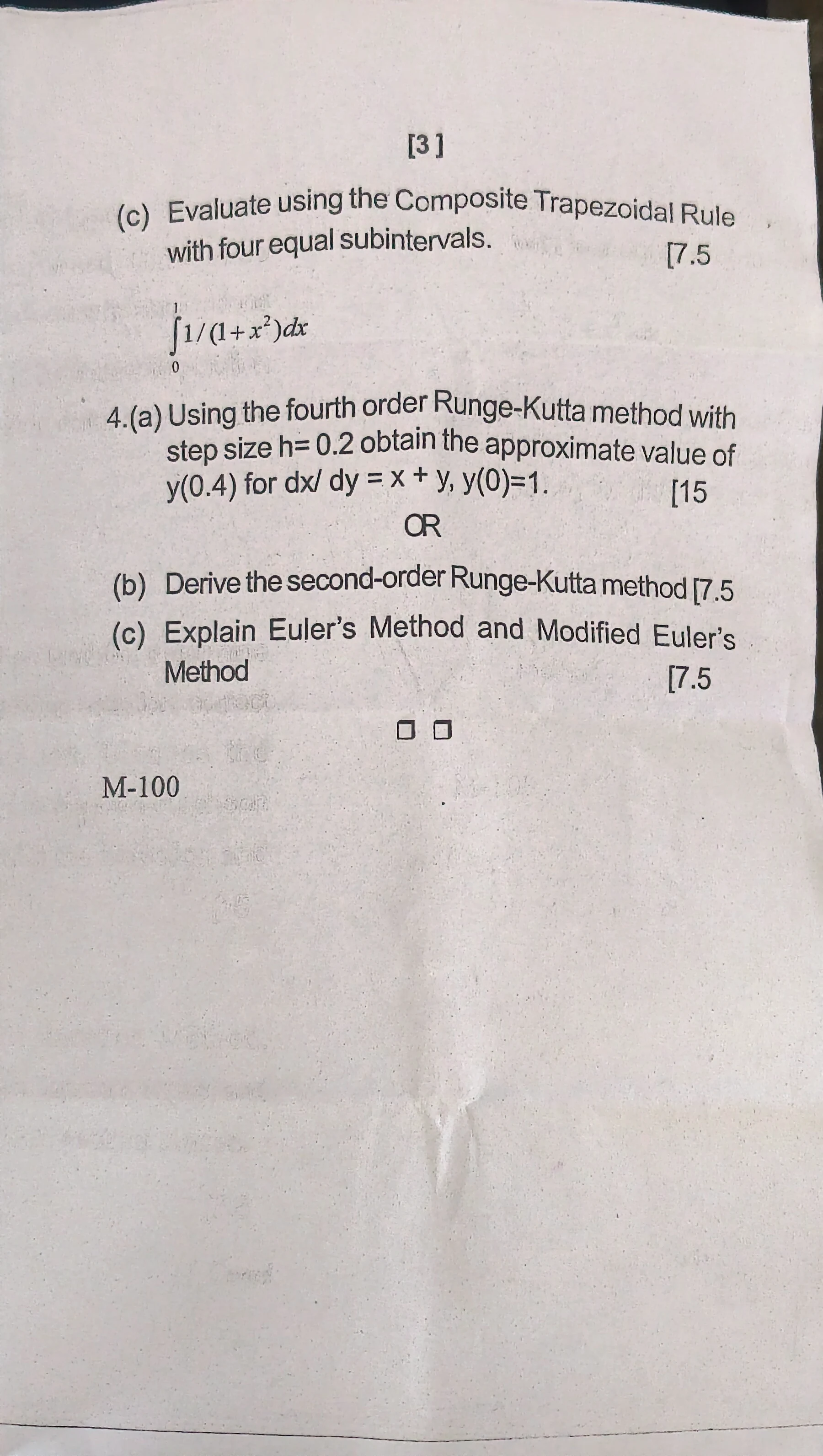
(c) Evaluate using the Composite Trapezoidal Rule with four equal subintervals: [7.5 Marks]
(a) Using the fourth order Runge-Kutta method with step size , obtain the approximate value of for , with .
(b) Derive the second-order Runge-Kutta method. [7.5 Marks]
(c) Explain Euler's Method and Modified Euler's Method. [7.5 Marks]