AUTHENTIC EXAMINATION ARCHIVE

2025 Database Management Systems Question Paper

MCA 2nd Semester Database Management Systems • MPC Autonomous College, Takhatpur, Baripada

Course
MCA
Semester
Semester 2
Year
2025
Exam Type
Regular

Original Examination Scans (2)

Verified Pages
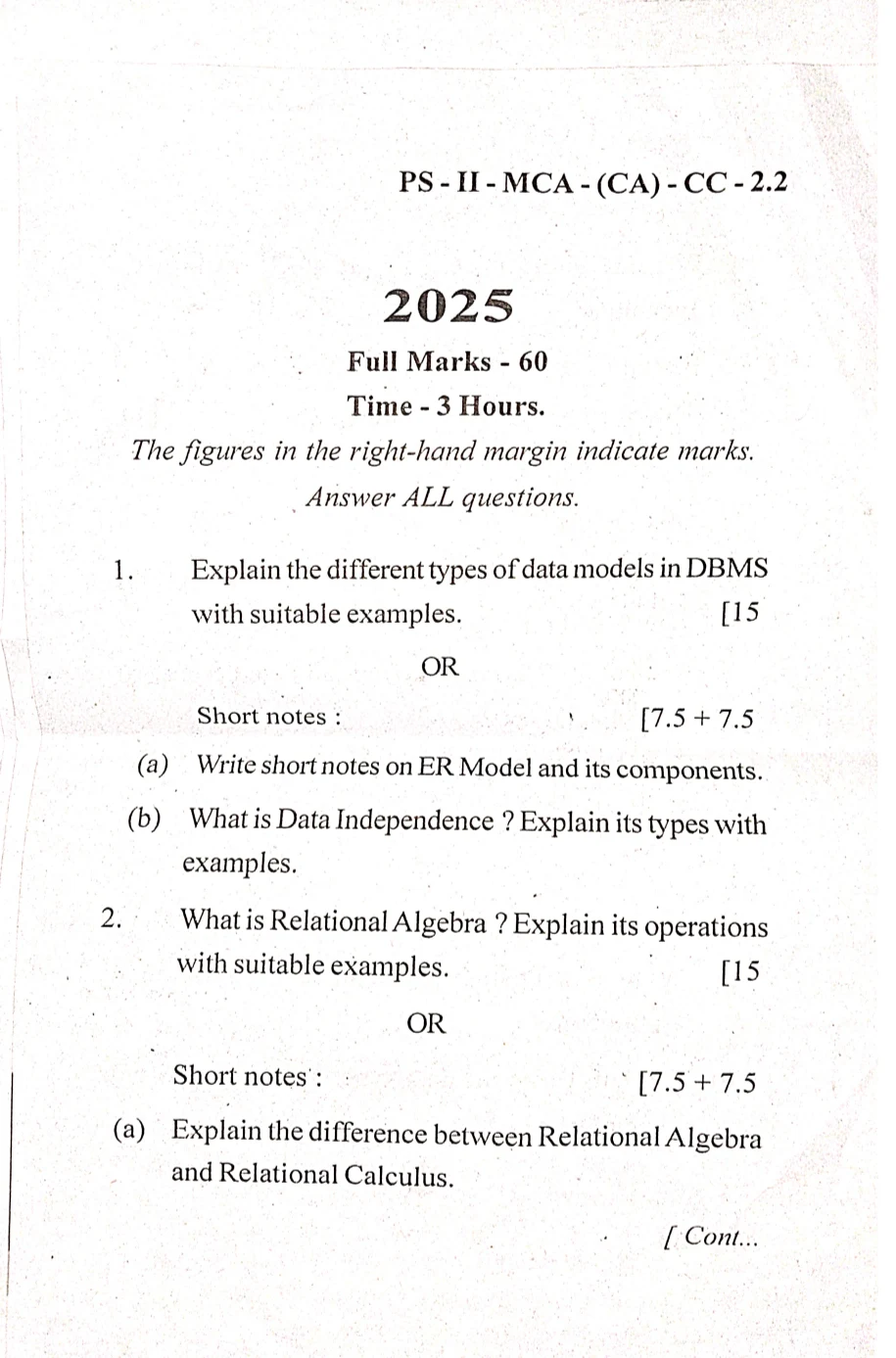
2025 Database Management Systems question paper page 1, MPC Autonomous College, Baripada
Page 1: Database Management Systems (2025)
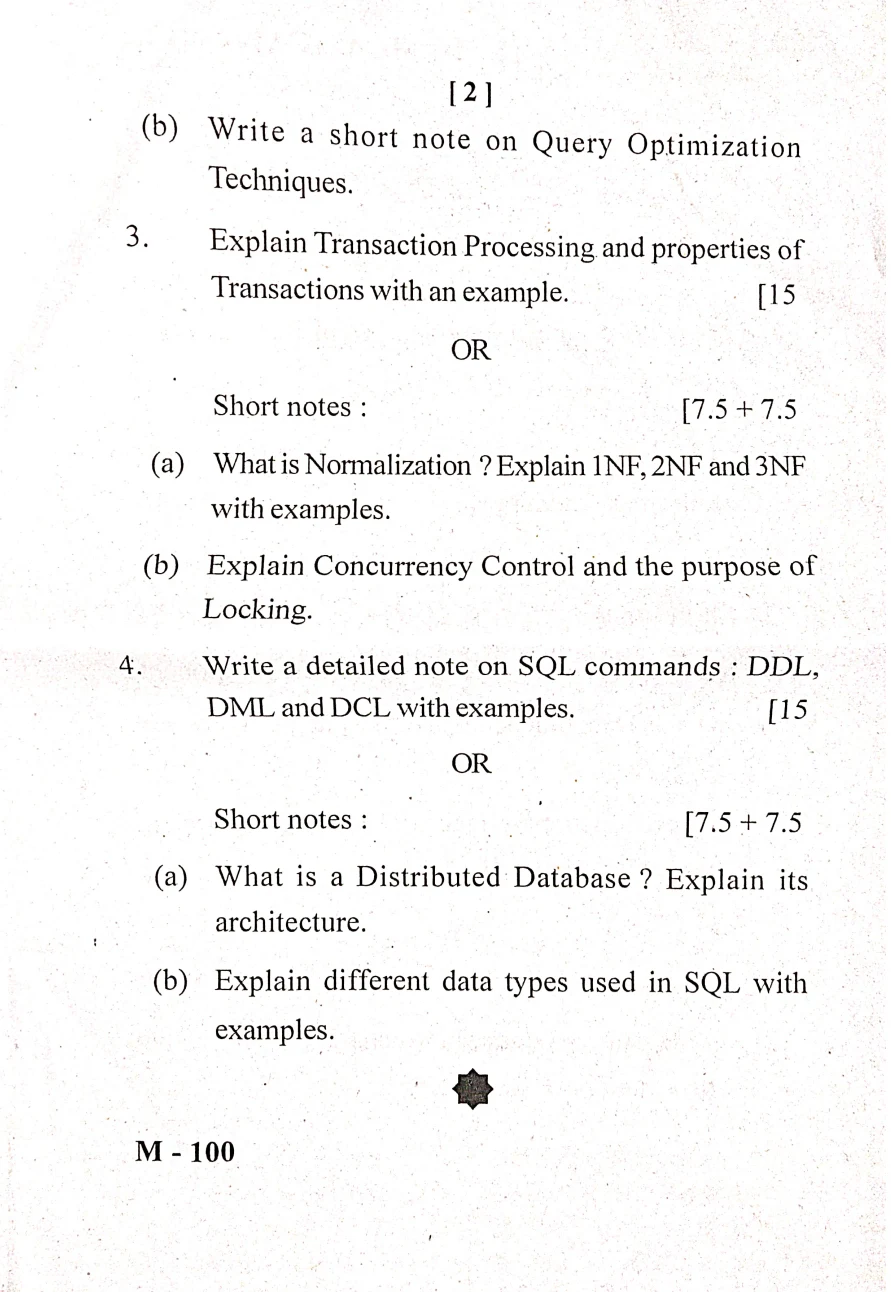
2025 Database Management Systems question paper page 2, MPC Autonomous College, Baripada
Page 2: Database Management Systems (2025)

Database Management Systems (CA-2.2) 2025 Questions

Transcribed questions for Database Management Systems (MCA, Regular 2025) including all sections, choices, marks, equations, and diagrams.

Unit 1 - Data Models & ER Architecture

Q.1 [15 Marks]

Explain the different types of data models in DBMS with suitable examples.

OR

Short notes: [7.5 + 7.5 = 15 Marks]

(a) Write short notes on ER Model and its components.

STUDENT ENROLLS COURSE RollNo CourseID M N
Entity-Relationship model with entities, relationship diamond, and attributes

(b) What is Data Independence ? Explain its types with examples.

Unit 2 - Relational Algebra & Query Optimization

Q.2 [15 Marks]

What is Relational Algebra ? Explain its operations with suitable examples.

OR

Short notes: [7.5 + 7.5 = 15 Marks]

(a) Explain the difference between Relational Algebra and Relational Calculus.

(b) Write a short note on Query Optimization Techniques.

Unit 3 - Transactions, Normalization & Concurrency

Q.3 [15 Marks]

Explain Transaction Processing and properties of Transactions with an example.

OR

Short notes: [7.5 + 7.5 = 15 Marks]

(a) What is Normalization ? Explain 1NF, 2NF and 3NF with examples.

(b) Explain Concurrency Control and the purpose of Locking.

Unit 4 - SQL Commands & Distributed Databases

Q.4 [15 Marks]

Write a detailed note on SQL commands : DDL, DML and DCL with examples.

OR

Short notes: [7.5 + 7.5 = 15 Marks]

(a) What is a Distributed Database ? Explain its architecture.

(b) Explain different data types used in SQL with examples.