AUTHENTIC EXAMINATION ARCHIVE
2025 Operating System Question Paper
MCA 1st Semester Operating System • MPC Autonomous College, Takhatpur, Baripada
- Course
- MCA
- Semester
- Semester 1
- Year
- 2025
- Exam Type
- Regular
MCA 1st Semester Operating System • MPC Autonomous College, Takhatpur, Baripada
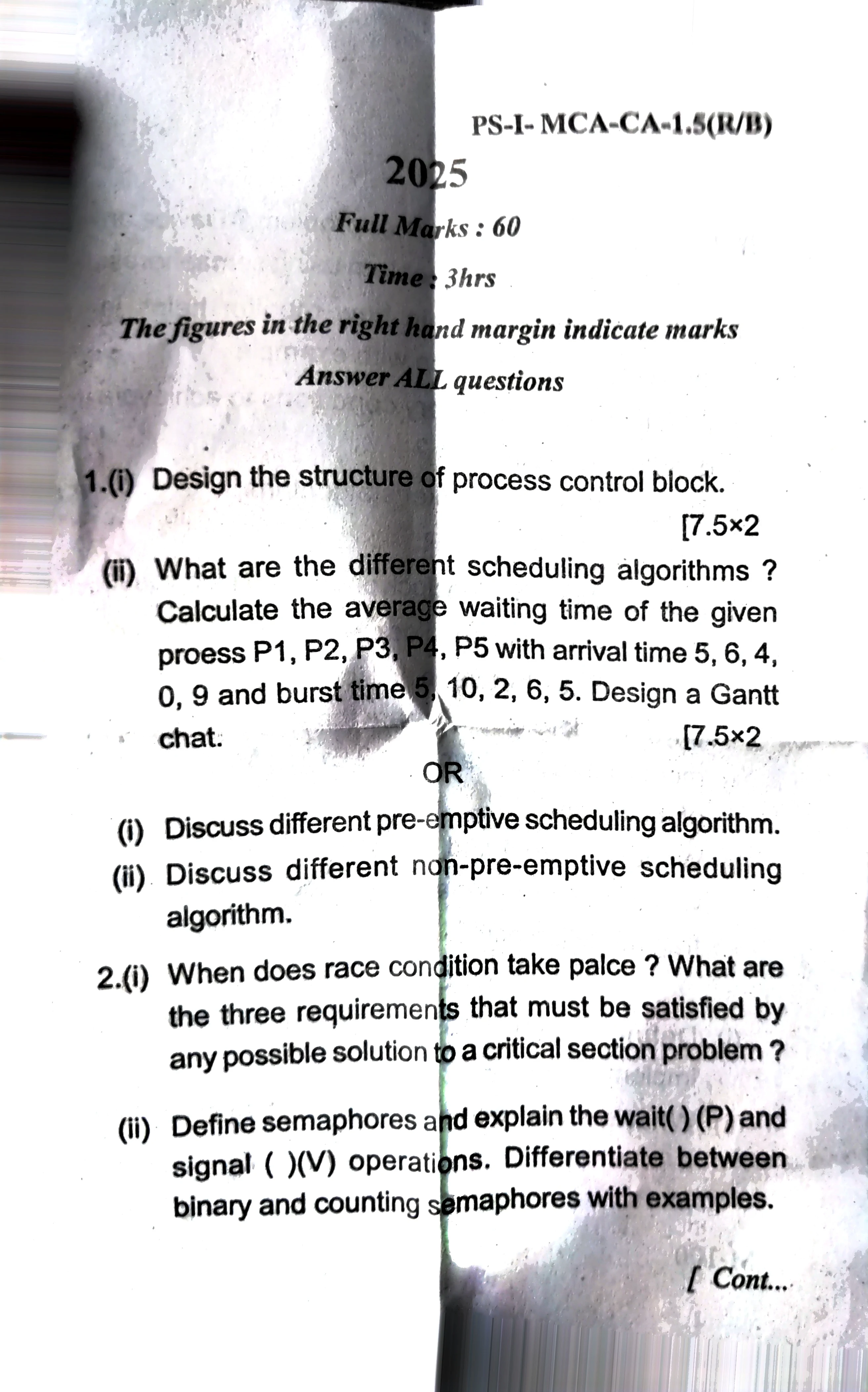
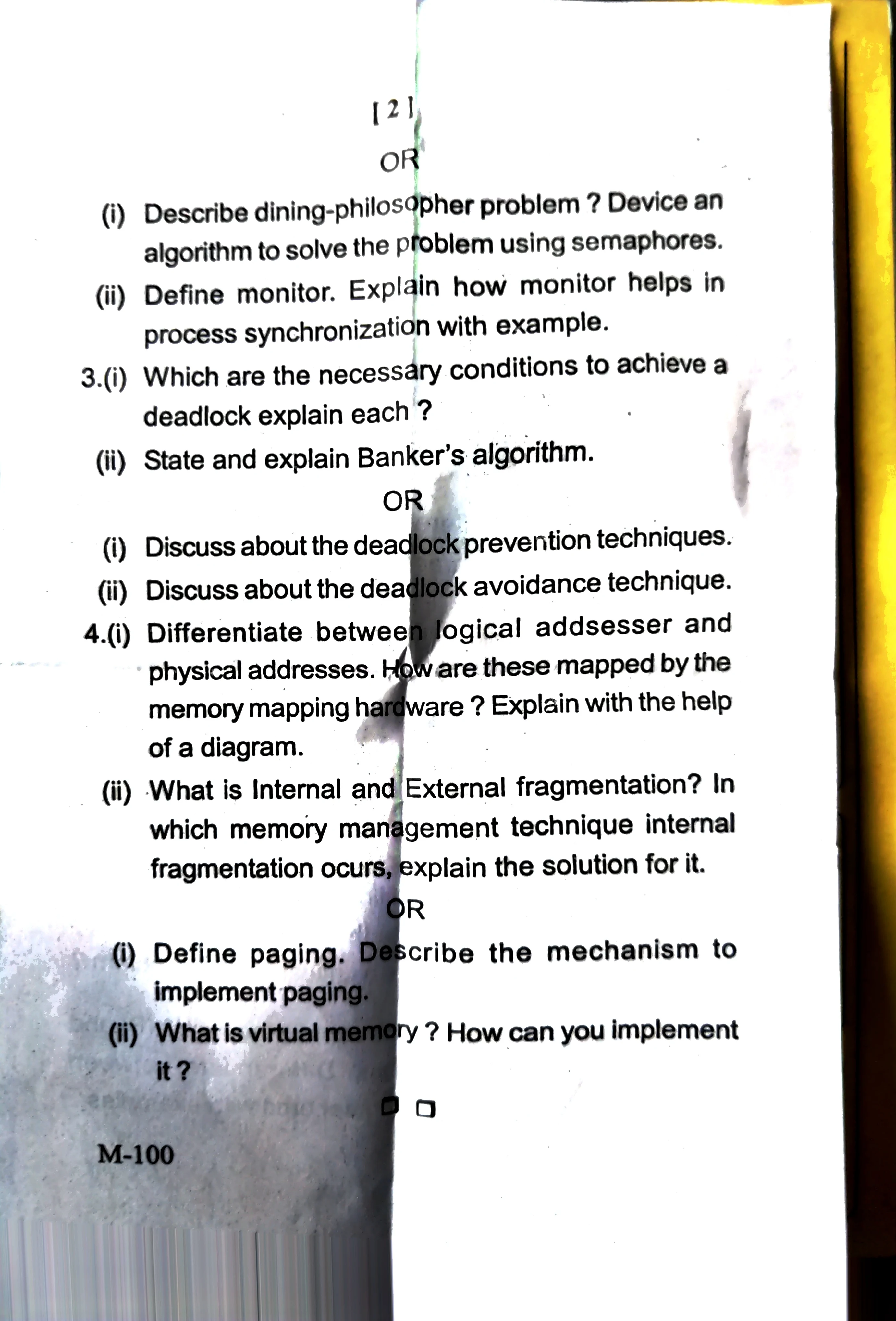
Transcribed questions for Operating System (MCA, Regular 2025) including all sections, choices, marks, equations, and diagrams.
(i) Design the structure of the Process Control Block (PCB). Explain each field: Process ID, Program Counter, CPU registers, CPU scheduling information, Memory management info, and I/O status.
(ii) What are the different CPU scheduling algorithms? Calculate the average waiting time and turnaround time of the given processes P1, P2, P3, P4, P5 with arrival times (5, 6, 4, 0, 9) and burst times (5, 10, 2, 6, 5) using FCFS. Construct a Gantt chart.
(i) When does a race condition take place? What are the three requirements that must be satisfied by any valid solution to the critical section problem (Mutual Exclusion, Progress, Bounded Waiting)?
(ii) Define semaphores and explain the wait() (P) and signal() (V) atomic operations. Differentiate between binary and counting semaphores with examples.
wait and signal) with an example. [7.5 Marks](i) Which are the four necessary conditions to achieve a deadlock? Explain each: Mutual Exclusion, Hold and Wait, No Preemption, and Circular Wait.
(ii) State and explain Banker's Algorithm for deadlock avoidance with Safety Algorithm and Resource Request Algorithm.
(i) Differentiate between logical addresses and physical addresses. How are these mapped by the memory mapping hardware? Explain with the help of a diagram:
(ii) What is internal and external fragmentation? In which memory management technique does internal fragmentation occur, and explain the solution for it (paging and variable partition allocation strategies).