AUTHENTIC EXAMINATION ARCHIVE
2025 Computer Graphics Question Paper
MCA 3rd Semester Elective 1 • MPC Autonomous College, Takhatpur, Baripada
- Course
- MCA
- Semester
- Semester 3
- Year
- 2025
- Exam Type
- Regular
MCA 3rd Semester Elective 1 • MPC Autonomous College, Takhatpur, Baripada
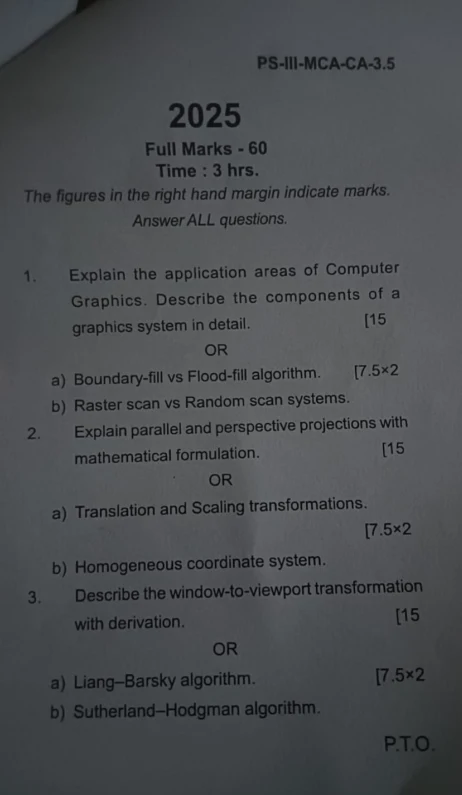
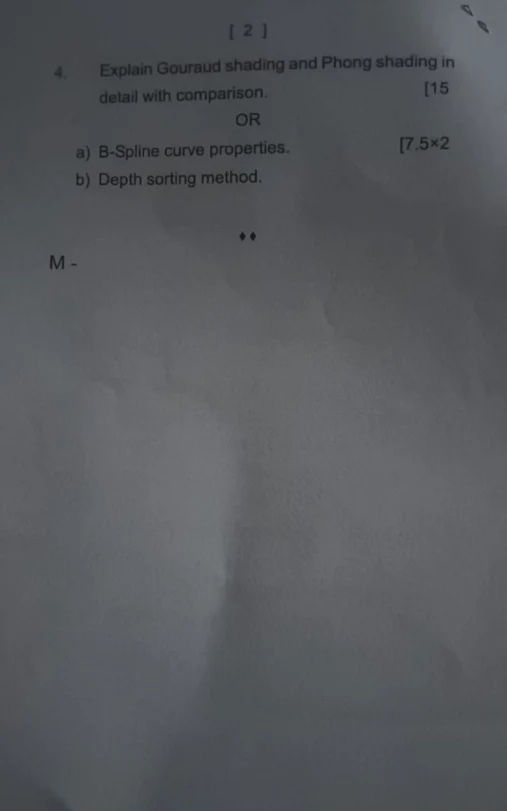
Transcribed questions for Computer Graphics (MCA, Regular 2025) including all sections, choices, marks, equations, and diagrams.
(a) Explain the Digital Differential Analyzer (DDA) line drawing algorithm. Calculate all intermediate pixel coordinates for a line segment between points and .
(b) Explain Bresenham's circle drawing algorithm with mathematical derivation of initial decision parameter .
(a) Explain Boundary-fill and Flood-fill algorithms for polygon filling. Differentiate between 4-connected and 8-connected boundary fill.
(b) What is aliasing in raster graphics? Explain anti-aliasing techniques: supersampling, pre-filtering, and post-filtering.
(a) Explain 2D geometric transformations: Translation, Rotation, and Scaling using homogeneous coordinate matrices. Derive composite matrix for rotation about an arbitrary point .
(b) Explain Cohen-Sutherland line clipping algorithm. Describe 4-bit region code assignment (TBRL) and line intersection formulas.
(a) Explain Sutherland-Hodgman polygon clipping algorithm with all four clipping cases (in-to-in, in-to-out, out-to-out, out-to-in).
(b) Explain 2D reflection and shear transformations with their respective transformation matrices.
(a) Explain Window-to-Viewport coordinate transformation. Derive the scaling factors and and write mapping equations to transform coordinates from world window to viewport display:
(b) Differentiate between Parallel Projection (orthographic, oblique) and Perspective Projection (single, two, three vanishing points) with diagrams.
(a) Explain 3D geometric transformations: 3D translation, 3D scaling, and 3D rotation about X, Y, and Z axes using homogeneous coordinate matrices.
(b) Explain the Depth-Buffer (-buffer) algorithm for hidden surface elimination with step-by-step algorithm and pseudo-code.
(a) Explain Gouraud shading (intensity interpolation) and Phong shading (normal vector interpolation) models. Compare their visual quality, computational complexity, and specular highlights.
(b) Explain Bezier curves. State their key mathematical properties: convex hull property, affine invariance, and write Bernstein polynomial formulation.
(a) Explain color models in computer graphics: RGB, CMYK, and HSV/HSL color spaces with diagrams and color reproduction applications.
(b) Write short notes on: